
Seven days is enough to prepare properly for the written driving test — if the week is structured. The difference between candidates who pass after a week and candidates who “studied all week” and failed is rarely effort; it is sequence. Unstructured studying drifts toward whatever feels comfortable, which means re-reading familiar material and avoiding the topics that are quietly weak. This plan fixes the sequence for you. It assumes about 45 to 60 minutes a day, uses your state’s official handbook plus PassDrill’s drills, and ends with you walking in rested rather than crammed. If your test is further away, simply repeat days 3 to 6 across two weeks.
Day 1 — Map the territory
Read your handbook’s table of contents and take a cold 10-question PassDrill test before studying anything. Record the score and which categories hurt. Then read the signs chapter — the most self-contained and confidence-building part of any handbook — and finish by drilling the signs category. End the day by starting your numbers sheet: one page where every distance, limit and penalty you encounter this week will be written down.
Day 2 — Right-of-way and intersections
Read the chapters on intersections, right-of-way and traffic lights. These rules are logical but layered: pedestrians first, then the choreography of four-way stops, uncontrolled intersections, left turns and emergency vehicles. Drill the right-of-way category until you can clear it in full, and for every mistake, say the rule aloud in one sentence (“first to stop, first to go; ties go to the right”). Speaking the rule is a small trick that measurably improves retention.

Day 3 — Speed, space and defensive driving
Read the material on speed limits, following distance, lane changes and hazard awareness, then work through both the speed and defensive driving drills. This is also the day to review your numbers sheet properly for the first time — following-distance seconds, school-zone speeds and stopping distances should start to feel familiar rather than new.
Day 4 — Alcohol, drugs and the law
Read the DUI chapter end to end. It is short and it is heavily tested. Learn the legal limit, what implied consent commits you to, the shape of the penalties, and the effects timeline of alcohol. Drill the DUI category twice. Then read the parking rules and drill parking as well — parking questions are small, factual and very winnable, especially the hill-parking wheel directions and the distances from hydrants, crosswalks and intersections.
Day 5 — Sharing the road, and a mid-week exam
Read the sections on sharing the road: trucks and their blind spots, motorcycles, bicycles, pedestrians, school buses and funeral processions. Drill the sharing category. In the evening, sit a full simulated test in exam conditions — phone away, no pausing — and grade yourself against the 80% benchmark. Note every miss by category; tomorrow is built from that list.
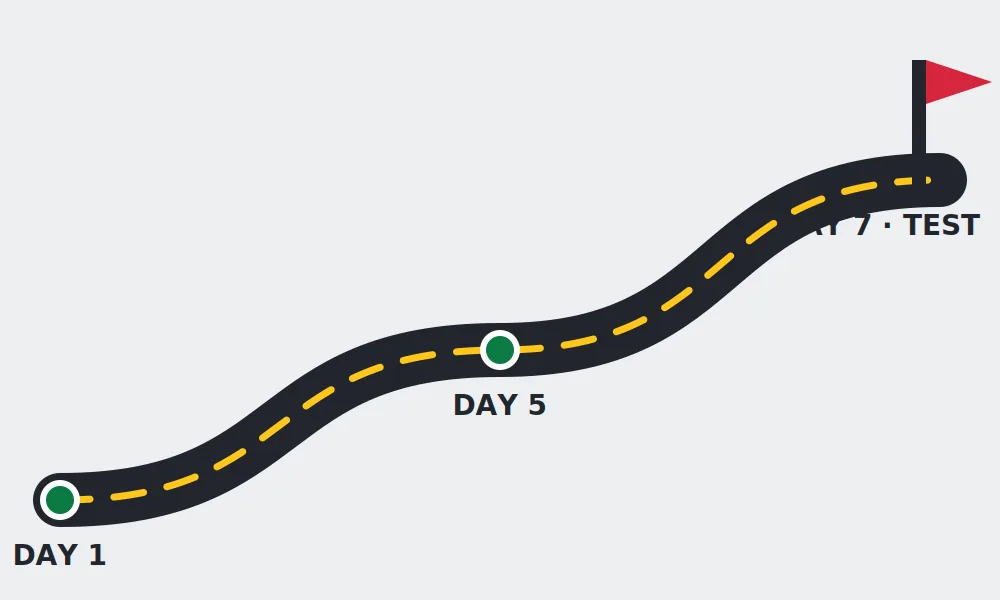
Day 6 — Weakness day
No new material today. Re-drill only the categories and question types you missed on Day 5, re-read just those handbook pages, and review the numbers sheet until you can recite it. Sit one more simulated test in the evening. The target is 9 or 10 out of 10 — and if a category still leaks marks, give it one final focused drill rather than spreading effort across everything. Finish early; prepare your documents folder tonight using the documents guide, and lay out what you will wear and carry.
Day 7 — Test day
Study nothing new. Skim the numbers sheet once over breakfast, check the folder, and leave with time to spare. In the test room, read each question twice, eliminate obviously wrong options, and choose the most rule-based answer that remains. If a question stumps you, mark your best reasoned guess and move on — protecting your rhythm matters more than any single question. When you finish, if your centre allows review, use leftover time only to re-check questions you flagged, not to second-guess the ones you knew. You have done the work across seven deliberate days; test day is simply where you collect it. And if the result surprises you the wrong way, our guide to why people fail will show you exactly what to fix before a prompt retake.
If life interrupts the plan
Real weeks misbehave: shifts change, children get sick, energy vanishes. The plan bends rather than breaks if you protect two rules. First, never skip two days in a row — a fifteen-minute drill on a bad day preserves the chain and the habit, which matters more than any single session’s size. Second, if you lose a full day, do not double the next day’s load; simply slide the sequence forward and, if necessary, move the test appointment. A test taken three days later with the plan completed beats a test taken on schedule with days five and six crushed into one exhausted evening. The plan serves the pass, not the calendar.
How to use PassDrill inside the plan
Every drill in this plan lives on the home page: the mixed test for cold starts and simulations, and the seven category buttons for targeted days. After each drill, read the explanations before looking at your score — explanations are where the learning sits, and scores are only the receipt. Keep a simple log, on paper or in your phone, of each day’s drill scores by category. By Day 5 that log becomes the most honest readiness report available to you: categories at full marks twice running are done, and anything still leaking tells Day 6 exactly where to go.
Start Day 1 now: take the cold test — your honest starting score is the plan’s foundation.